History of the surf leash repeats itself in river surfing.
Jack O’Neill was born ironically in Denver, CO on March 27, 1923. Though as a youth, Jack O’Neill moved with his family to California to discover body surfing and stand up surfing. Jack O’Neill later in life created the first surf wetsuit company, known as O’Neill Wetsuits, that by the 1980’s became the world’s largest recreational wetsuit company. But why does the iconic logo of Jack O’Neill have a pirate’s eye patch over his left eye?
In 1970, Jack O’Neill’s son Pat O’Neill attempted to invent a surfboard leash that was fashioned out of rubber surgical tubing connecting the surfer from the wrist to the front of the surfboard with a strong suction cup. It was an odd looking contraption to say the least.
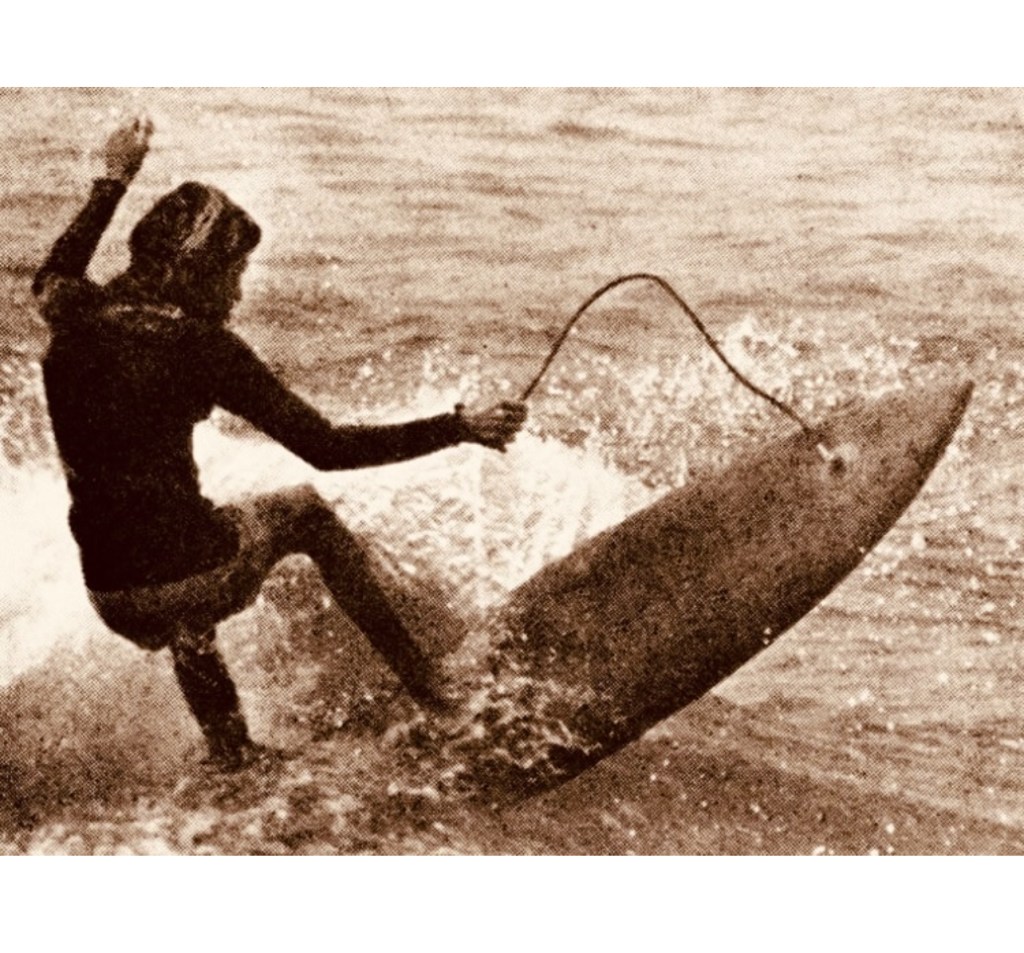
By 1971 Pat O’Neill’s leash was modified/improved to attach to the back of the surfboard and to the surfers ankle. The leash was advertised as “safe” but in reality it was not because the rubbery leash would stretch too far. Jack O’Neill apparently went surfing about that time testing his son’s modified leash. Unfortunately after a wipeout, the too stretchy leash shot Jack O’Neill’s surfboard back into his face and took out his eye. All was not lost (well, besides his eye) as Jack O’Neill’s stoic front profile of wild flowing hair, an unkept beard, and an eye patch became one of the most iconic surf company symbols to this day.

By 1972, the surfboard leash was improved again with the urethane cord that provided for a more predictable stretch of the leash; however, the surf leash divided the surfboard world. The purists claimed the leash was an unneeded crutch that hid the lack of surfer’s skills and their inabilities of surfers to control their boards. As a result the surfboard leash was nicknamed the “KOOK-CORD”.
Others claimed that the surfboard leash saved surfboards from running way from them when surfing their surfboards doing never before attempted turns and tricks. In the end, with the shortboard evolution winning over surfing, the leash became a normal part of ocean surfing, excluding longboarding.
All was well in surfing and leashes until a fateful day at Mavericks wave on December 23, 1994 where well respected big wave surfer Mark Foo died when his leash got hung up on the rocks after a hard fall and while being pummeled by a set of huge waves. Suddenly the surfing world realized that previously ignored leash hold down deaths had also taken one of the best big wave surfers. It was then that the quick-release leash (QR leash) was invented. That leash remains today as made by XM/Surfmore that is either attached to the ankle or above the calf/below the knee and utilizes a pin attached to a loop that when pulled, releases the connection point of the surfer to the leash. Currently this type of QR leash is the only one accepted as safe for surfing ocean.
So where is river surfing’s leash history? Well many surf with a standard ankle leash in the river despite most would agree is highly dangerous if the surfer is held under since an ankle leash is hard to get to and very difficult to undo the velcro cuff. Some river surfers use the XM style QR leash, but this is the type of QR leash that was likely used during the Bend Wave fatality of 17 year old Ben Murphy. And sadly in Colorado and beyond, river surfing has blindly co-opted the downriver SUP quick release snap-shackle (aka SUP QR leash) that was never intended or even invented for surfing river waves built in whitewater park environments like RRP, Scout, Montrose, Boise, Bend, etc. Somehow the SUP QR leash has been advertised and accepted as the safe gold standard safe leash for river surfing; that in reality, SUP QR leashes are improperly used, dangerous, and have contributed to many near deaths and fatalities as reported on the American Whitewater Accident Database.
Currently the river surfing community is divided about the QR leashes into many camps:
- Those who have set their risk tolerance to accept the fact that the QR leashes of all kinds (including attached to rescue vest pfd’s) and accept the fact that QR leashes do not include fail-safe self releasing mechanisms.. but still choose to risk their lives surfing with QR leashes of all types, especially the SUP QR leash.
- Those that are completely clueless and uneducated about the risks of any type of QR leashes while river surfing, not due to willful ignorance but due to being negligently told that QR leashes, especially the SUP QR leashes, are safe if not completely safe for river surfing.
- Then there are those like the American Whitewater Association who allow their various bias and bad heuristic decision making traps to not recognize the red flag dangers of QR leashes and do some sort of research or take a stance; or worse yet, unknowingly or knowingly whitewash reports of QR leash accidents and deaths by blaming the victims and/or ignoring facts, eyewitness accounts, and statements to make it appear that the QR leash had nothing to do with reported accidents and fatalities.
- Then those who are so against QR leashes in the river that they will not river surf with a leash at all, even if it means loosing their board instead of loosing their lives; or even not surfing certain river waves that are hard to not loose a board to the river.
So where do we stand with the river surfing leash? Who will be the next Jack O’Neill who will get their eye taken out, or worse, by leash that helps the surfboard hunt your head with when you come off the river wave? Are leashes in the river waves a crutch that hides the fact that far too many river surfers do not know how to safely control their boards coming off a river wave and to the eddies? Do leashes give a sense of false sense of safety in an unsafe environment to include: inability to deploy/release a leash while held under water; and contributes to flush drowning when unable to deploy/release a leash when being dragged through rapids and wave trains by their boards?
When you dig into enough, the surf leash for ocean surfing is still a controversial topic. For river surfing, surf leash controversies are in a much worse state of affair than ocean surfing leashes and there seems to be little effort to address the river surfing leash controversies.
LBK
Comments are open on this article.
 The Denver Surf Report
Interesting read! Learned something new about O’Neill. I agree that manufacturers should create a fail safe or better system for this issue.
Yep. History of surfing is interesting how it impacts all board sports. Would be cool to find his birth place and childhood home in Denver…. Also agree with a fail safe and better leash system. Hope we get our heads together on this!
Potential 50 leash considerations and pros/cons for river surfing as part of overall risk management. Draft, open for suggestions and hoping to continue raising awareness on this multi-faceted and challenging issue. These are some of the potential risk considerations to make a personal leash decision. Just a general risk consideration/management process, not tested/confirmed. Leashes and all of river surfing has inherent risk.
A.L.O.H.A!
Initial Considerations
-Do I need a leash to potentially increase my individual overall river surf safety at this location/flow and given my abilities? If not, typically avoid it. If you believe its needed for safety, continue to assess risks below.
-Whats my swimming and paddling ability – beginner, intermediate, advanced?
-Can I catch the wave, surf, kick out and control my board? Vs constantly swimming?
Assess River Entanglement Risks
-Is the river shallow behind the surf feature? Or is it a deep water location? Note – this is one of the most important assessments for leashes. Leash risk entanglement increases significantly in shallow areas.
-Am I or others often encountering the bottom while surfing the wave, or when exiting?
-Are there strainers in vicinity including downstream of feature? Note – consider assessing strainer risk ½ mile down river.
-Are there visible rocks in the surfing area that could contribute to entanglement (eg surfer floats to one side, board to other)?
-Are there rapids to swim or paddle through?
-While eddying out, do I swim/paddle over fast moving and shallow water (eg with leash potentially dragging on river bottom)?
Assess River Feature/Wave Risks
-Is the feature itself shallow (sheet flow)?
-Is it a engineered/designed feature or natural wave?
-Does the feature/wave have leash catch locations (blocks, gaps, openings, rebar, wedged trees or branches)? Has this been assessed in low flow?
-Does floating in from above or side of feature have specific leash entanglement risks?
If there are shallow river or shallow wave feature risks – consider stop here and avoid leashes.
Assess River Eddy and Down River Risk
-What are current flow conditions – high flow, med or low?
-How does flow change leash entanglement risk? How does flow affect rescue?
-Does quickly making the eddy (by a direct swim, avoiding time to gather board) reduce overall risk at the location?
-If I loose my board and chase it – what are the specific risks? Leg entrapment, flush drowning, strainers, hydraulics?
-Have I thoroughly weighed chasing board downriver risk vs entanglement risks? Note downriver board chase and retrieval in high flow river surfing is one of the most hazardous activities in river surfing. You may be swimming up to 1/2 mile downriver from the river wave location.
-Do I have a basic understanding of leg entrapment, flush drowning, strainer, hydrualic hazards/risks and ways to mitigate them while chasing/swimming for my loose board?
-Do I have other PPE/gear to deal with flush drowning, strainer, recirculating hydraulic risks?
-Have I scouted for down river board chase and retrieval? Note: Consider 1/4-1/2 mile scout in high water.
-Is there someone to potentially assist with board chase and retrieval?
-Is it a high flow river surfing location have large whirlpools or large wave train risks that could contribute to drowning risk?
-Do I need to be on my board quickly to help avoid whirlpool or large wave train drowning risks?
Assess Kick Out Risks
-If I can effectively kick out, is my board typically nearby?
-Can I kick out towards an eddy?
-If I kick out and start immediately swimming for the eddy, does that help decrease overall river surfing risks by quickly making the eddy? Note this technique is not always possible, but quickly getting to the eddy gets you to the the safest river location in river surfing – the eddy.
-Does quickly getting distance from your board after falling off your board – help avoid board to head strike risks? Note board strike to head is one of the most common river surf injuries. Using or not using a leash both can affect board head strikes risks. Board strikes have potential to cause surfer significant injuries.
-If I kick out, and keep board near, and have risk of landing on it – does it increase shoulder dislocation risks (eg awkward fall on board)? If my shoulder is dislocated, does it add to drowning risk given wave location?
-Do I use a board with more kick out/head strike risks due to board material (e.g. carbon fiber, polycarbonate)?
Assess Gear (if you choose to wear a leash – based on personal determination based on risk, assessment, experience)
-Do I have a quick release leash? Note – all leashes/equipment have limitations. Standard ankle leashes should never be worn.
-Has my quick release system been fitted for me?
-Does my quick release actually release (not rusted shut)?
-Can I reach the quick release physically if under tension (not typically for ankle leashes, and calf can also be difficult under tension)?
-Will the quick release location move under tension (eg waste belt go to rear, making it impossible to reach)?
-Have I practiced using the quick release? Practiced under tension?
-Will the leash break under stress?
-Is there a way to add an additional break/release point if leash is under tension (e.g light weight cable tie)?
-Whats the lowest risk location I could connect the leash to myself? E.g. arm (allow it to slip off as additional redundancy), other areas?
-How long is my leash? Could it be shorter? Note: dragging a too long leash when paddling increases entanglement risk.
-Do I have a comp leash (typically 5 mm) or a thicker big wave leash? Note: comp leashes may break more readily in entanglement incident.
-Does my quick release have the potential to accidentally release unexpectedly, leading to unwanted board chase?
Assess Rescue
-Am I surfing with other knowledgeable and experienced surfers?
-Do they have swiftwater training, and are they willing to rescue?
-Are they familiar with rescue methods for leash entanglement?
-Do they have throwbags (possibly can assist with entanglement rescue to hold rescuee up)?
-Do they have knives?
-Do rescuers know how to operate my quick release?
Imagine being prone and 1000s of pounds of water force against your body, either head up or down. This is your typical leash entanglement rescuee position. Self rescue is very difficult. It is frightening – having rescued a close friend from this position.
Thanks for reading, add any considerations missed below. A.L.O.H.A!
Forgot a few key ones.
-Assess wave feature for a secondary hydraulic. A secondary hydraulic can be found behind some surf waves and can take rider to bottom, or near the bottom after rides. Secondary hydraulics can increase leash risk. Examples – Boise Phase 2, Boise Phase 1 Wave Shaper 3 (note WS2, main wave surfed most of year, typically doesnt have a secondary hydraulic)
-Surfer overall buoyancy – when assessing leash risk consider overall buoyancy between wetsuit and any PFD/buoyancy device. A more buoyant surfer may be less likely to be recirculated or have river bottom contact, potentially lowering bottom hazard encounters and entanglement risk some.
Loren, you always come to the discussions with excellent information, suggestions, instructions, and ideas for river surfing. Thanks so much…. My takeaway from your insight into leashes is that; river surfing may look simple enough but it is far from that. One can’t just look at their personal calendar and say, ah I’m free and such and such river wave is up let me pull out my gear and go. Much more complicated than that. Just like backcountry snowboarding or skiing, you need to know conditions before you go and be educated and have the right gear and be proficient in that gear; river surfing is the same except the river surfing community at large does a poor job at that for many reasons. Though I have to say there are places like the Boise Waves in particular that actually gets it and gives regular updates and surf condition reports about how the wave is surfing (live quality cam is key to this) and any concerns of safety if need be. In Colorado, the onus is placed the individual to figure out the conditions of the wave for surfability and safety with a result of sketch ass surfing, near death accidents, and deaths. One thing to paddle into to some hard to get to natural formed river wave and be one’s own keeper of safety, but when municipalities build these whitewater parks there needs to be an acceptance of responsibility to the dangers by the municipalities to mitigate like what Boise and Bend does.