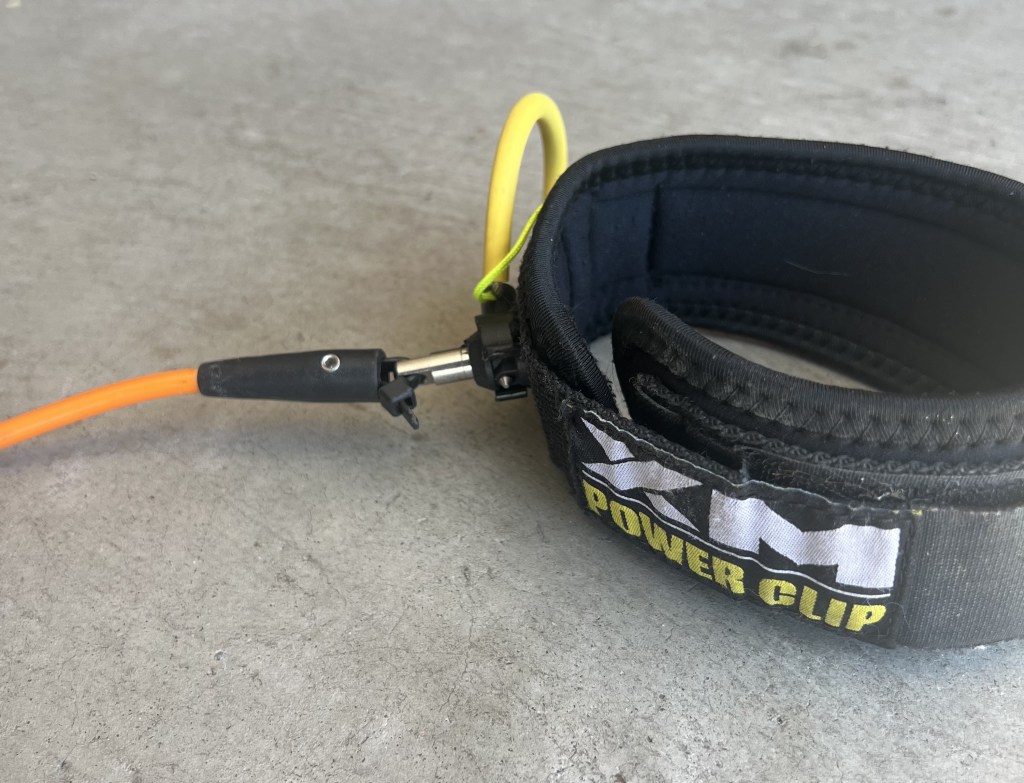
DO THIS MOD AT YOUR OWN RISK!! ALL LEASHES CAN KILL YOU. LEARN TO RIVER SURF W/OUT A LEASH AS MUCH AS POSSIBLE.
With much trepidation I will explain a simple do-it-yourself way to make a self releasing leash, that might save your life. Note, this zip tie mod been used by river surfers for years but has NEVER BEEN TESTED IN A LAB SETTING.
OVERVIEW: Modify your leash with a zip tie at the connection point to your body so if for some reason you cannot quick release your leash in a hold down situation, the zip tie (in theory) will break and release you, hopefully before you drown.
WHAT YOU NEED:
- 50lb black UV resistant cable tie (aka zip tie)
- Fin key or Allen key (3/32 Stainless Steel Hex Key Wrench)
- Scissors
- Sand paper
- Leash w/ swivel end (you don’t really need a leash to river surf but..)
HOW TO DO IT:
- Check your leash for a swivel connection at the end of the leash at the cuff or part that is up by the quick release snap shackle that has a grub screw through it that can be removed with a fin key or Allen key.
- If the leash does not have a swivel end with a grub screw that can be removed, take a pair of scissors and cut the leash right at the cuff or part near the snap shackle and throw both parts in the trash because it is a cheap “bunk” leash that will kill you!!!
- Remove the grub screw with your fin key or Allen key. You will be putting the grub screw back in, so put it to the side (note this is the same grub screw used for fins, and if you lose a grub screw, your local Ace Hardware has them). Disconnect the leash from the swivel that is attached to the cuff or snap shackle end by simply pulling the leash apart.
- Take the UV resistant 50lb zip tie and bend it in half about an inch from the head (the part the tail will eventually feed through). You should use a lighter zip tie for smaller surfers such as groms.
- Push the bent zip tie into the end of the leash that you removed the grub screw from. Make sure you seat it in far enough that it passes the hole for the grub screw.
- Re-insert and screw the grub screw back into the leash end, thus capturing the bent side of the zip tie in the leash.
- Feed the tail through the eyelet hole of the swivel part of the cuff or snap shackle side and then into and through the zip tie head.
- Pull the zip tie to about 1/4″ slack tight. This will allow the leash to be in straight line with the cuff or snap shackle ring part. Make sure that it allows you to do so with enough slack that things straighten out. If the zip tie is too tight it will likely break too easily and you will need to cut the zip tie off and try again with another zip tie.
- Trim the excess tail off of the zip tie so it does not interfere with any quick release mechanisms.
- Trim and round off the sharp squared edges of the cut tail of the zip tie and then lightly sand down the tip of the tail to remove any remaining sharp plastic edges that could cut you or possibly the leash. The zip tie tail should be dull to the touch.
- Carry an extra bunch of zip ties, a “leatherman” type multi-tool, and maybe some extra grub screw with you to the wave (in the car) just in case you snap the zip tie while surfing (hopefully not from a hold down but possibly from falling off the wave and the board submarines on the front of the wave or in the secondary wave, etc).
- Show and share this zip tie mod idea with those who (based on an informed educated choice about the dangers of leashes) still want to use a leash. Maybe you can mod their leash right there at the wave for them and possibly save a life.
HOW TO USE IT:
- Best way to use this leash mod is to not use any leash. Spots like RRP and Bend either recommend no leash (RRP) or ban leashes outright (Bend, OR wave). Scout wave is another spot you do not need to use a leash since the back pool and eddy-outs are easy deal with and to get to.
- If you plan to use your zip tied modified leash, first practice your quick release mechanism a hundred (100) times so you form “muscle memory” of where and how to deploy your quick release. The first thing you want to do is use the quick release as soon as you are faced with a danger, for example about to go over shallow rocks or into rapids below a wave. Also you want to be able to find and pull your quick release within the literal few seconds you have to react to a hold down.
- In the river, be aware that the zip tie modified leash can and probably will inadvertently self-release at some time, so have a river exit strategy figured out before surfing any spot. Know your wave you are surfing and any downriver hazards because you may be swimming for you board or maybe just letting it go. Surf with a friend who can go get the board before it runs away from you and before the point of not going to go after it. Write you number on the bottom of the board so if you lose your board (and not your life) and when someone finds it, they can call you to get it back from them.
- STOP DOING THE SWIM DRAG THING TO THE EDDY. Learn to pull your board to you in a controlled motion to quickly get on the board and paddle to the eddy. The “unwarranted swim drag thing” often submarines the board and could inadvertently self-release the zip tie modified leash…. Also, the unwarranted swim drag thing is not for the typical palypark river wave because it is: bad form; dangerous to others in the eddy with sling shot boards (yes this happens way too often); does not translate to proper ocean surfing (uncontrolled boards from any swim drag in the ocean will hurt others, get you kicked out of the ocean surf break, and besides that, you will never make it outside to the line up doing the swim drag thing); AND the rest of the river surfers in the line-up queue are puking in their mouth watching the hideous unwarranted swim drag thing going on at the river wave.
- Caution, all river waves have hazards (some more than others). So give a critical look at the spot you are surfing before you jump in, especially with a leash. Are there cracks and spaces on the side of the walls you jump off of that will possibly snag your leash and hold you down to the point people (if even there) could not free you? Are there hazards in the face of the wave itself that could entangle your leash (wave shaper blocks, empty sand bag fluttering stuck in the wave, etc.)? Rocks behind the wave? Rocks in the powerful fast moving eddy? Strainers down river from the wave as you exit the river (tree limbs, rebar, etc) either visible or underwater ? Etc? Look for anything that could snag your leash, even if you have zip tie modified your leash.
TIPS:
- Educate yourself about leashes including quick release leashes. The American Canoe Association (ACA) says if you decide to use a leash it should be an “educated” choice.
- Know that in Sept 2023, Paddle UK organization (formerly British Canoe) has recommended that absolutely NO leash system should be used in the whitewater environment until a failsafe self-releasing leash is manufactured and sold to the public. See: https://paddleuk.org.uk/quick-release-leash-systems-in-a-white-water-environment/
- Retailers selling quick release leashes are remiss if they did not let you know that “Any Leash Can Drown Any Surfer“.
- Just because other people are surfing with leashes does not mean they know the dangers of the leashes or maybe if they do know the dangers of leashes, their risk tolerances are higher than yours. Same with those selling and/or renting leashes who often don’t educate surfers about the risks of any leash system.
- When using a leash, use a helmet because a surf leash in the river keeps the board within striking distances of your head, face, shoulders, and arms. Don’t take my word, watch the incredible number of near misses of river surfers corking/popping up in the secondary wave as the board hunts their head.
- When coming off the wave stay low in the water past the secondary wave if at all possible and as you surface come up with a hand up, and cover your head and face with at least one arm if not both arms as you clear the surface of the water… Better to take a board hit on the arms than on the face or forehead (that happens even when wearing a helmet), then look for your board and swim quickly toward it or give it a light tug to come back to you.
- Avoid the “unwarranted swim drag thing” as much as you can. Climb up on the board and paddle to the eddy. This likely means you will be catching the eddy a bit latter or you are going to paddle down to the next eddy out exit section of the river.
- Remember, your board is not worth your life… “Ah, but others will be ahead of me in the queue line-up because they use a leash that does not self-release.” Bummer, but you can always buy a new board, you can’t buy another life!!!
- Get used to your zip tie modified leash to eventually transition to surfing without a leash at places like RRP and Scout by telling your friends to help keep an eye on your board when you come off the wave. They will point to where board is drifting to help you out.
- Tell the river surf industry to come up with a tested viable self-releasing quick release leash.
Again this leash zip tip mod DIY is at your own risk. Personally, I will not surf with a leash at all even if it means skipping surf spots that require a leash (G-wood at surfable flow for example). Only reason I am proffering up this mod is people are unaware or turning a blind eye to the dangers of quick release surf leashes (both snap shackle and calf versions) situations that have caused multiple near death experiences (NDE’s) and fatalities.
Comments are open. Be cool and your comments will be posted up.
Be safe.
LBK
 The Denver Surf Report
Great write up on this. I’m leaning towards not wearing a leash at all, but need to practice at RRP first. WMy biggest issue was that I’d kick the board out if I started to fall and then the board and myself would get separated by what felt like a mile. I’ve gotten better, but sometimes when you’re hard charging it seems like you can “lose” the board quickly. I’m also a beginner/intermediate so still learning.
Can you do a guide on how to surf without a leash/exit strategies?
Thanks and great idea for a how to surf without a leash. Next article on my to do list!
I think it would be super helpful to have a guide on that. I think most may not know (myself included) in how to dismount properly. I’d be curious as to what the best practice is for a regular dismount and what to do if you lose control when you’re trying to “throw buckets”. I find that I’ll slip out and sort of kick the board away but I don’t think that’s the best move. Just some thoughts as I was rereading your post.
Good question.. Preview Of How To Dismount Off The Wave: I use a few methods depending upon the wave: Most stylish and risky is the kick-out like coming off an ocean wave surfing off one of the sides; Safest is squaring up on the river wave going straight and put slightly more weight on the back foot to flush out of the wave by going up and over the wave out the back while carefully grabbing the rails and lying down on the board just as you hit the top of the wave (I do this at Scout at all flows); Another risky one is to come off the back of the wave in a similar square up but jumping to the side of the board while trying to put one or two hands on the board but this can be sketch with a strong secondary wave like Scouts or bigger Sixx with an uncontrollable board; Then there is falling while pushing your surfing limits (try not to launch the board because there are often people in the eddy trying to get back up on the wave wall or from some unsafe reason, people just hang out in the eddy waiting their turn), stay deep under the secondary wave and come with a hand breaking the surface and other hand covering your face and head, then glance for your board and swim towards it, if you don’t see your board, look back at the wave and most likely someone is pointing in the direction of your board for you to swim to; Lastly, some waves like Sixx at times will eddy your board back to you or to others to grab for you… Guess I need some pics to clarify this… Watch what others are doing and note how it changes river wave to river wave and even flow to flow on how to safely dismount off your surfboard in a river wave….. Best to river surf with people who look out for each other and will even safely chase your board down for you if it gets too far away from you.. Hope this helps.
Dakine makes floating leashes. Floating throw ropes have been the standard for decades and it’s true, ropes on the surface are far less likely to snag. I’d say the best setup available today may be a floating leash, velcro waist belt, Dakine Easy Clip (no I’m not sponsored) used with zip tie, so you have two release points in case you can’t find one, and a zip tie. And all the situational awareness mentioned in this post. Surf every spot possible without a leash. There are certain deep water spots I’d use one.